Description
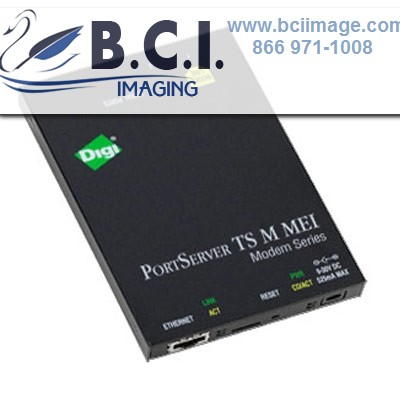
Digi PortServer TS M MEI 3 port RS232/422/485 serial device server w/(3) RJ45 RS232/422/485 ports, (1) RJ45 10/100BTX port, (1) RJ11 port, internal modem & Multi-Electrical Interface capability
70001899
The PortServer TS M MEI serial server offers Ethernet and RS-232/422/485 serial connections, with the addition of an internal modem. The one- and three-port serial servers are ideal for applications requiring both IP networking and standard phone line dial-up connectivity for remote access to serial devices.
The embedded modem adds another level of flexibility to the PortServer TS serial server family. It allows remote hosts to dial-in to a serial device attached to the Digi serial server, as well as the serial device to dial-out to a remote location using a standard phone line. The modem helps to create a PPP connection (TCP/IP connection over modem) so that applications and devices can communicate via an IP network, even when the primary LAN or WAN is not available. This allows users from a central location to maintain access to remote serial devices.
Other applications for PortServer TS M MEI include remote site console management for small branches and remote log-in via a TCP/IP network for easy troubleshooting, monitoring, configuration or control.
Features
Device server with one v.90/v.92 modem port
Access remote devices and IP networks
1 or 3 serial ports with internal modem
NIST FIPS-197 certified serial server
 |
 |
 |
|
The PortServer TS M MEI serial server offers Ethernet and RS-232/422/485
serial connections, with the addition of an internal modem. The one- and
three-port serial servers are ideal for applications requiring both IP
networking and standard phone line dial-up connectivity for remote access to
serial devices.
The embedded modem adds another level of flexibility to the PortServer TS
serial server family. It allows remote hosts to dial-in to a serial device
attached to the Digi serial server, as well as the serial device to dial-out to
a remote location using a standard phone line. The modem helps to create a PPP
connection (TCP/IP connection over modem) so that applications and devices can
communicate via an IP network, even when the primary LAN or WAN is not
available. This allows users from a central location to maintain access to
remote serial devices.
Other applications for PortServer TS M MEI include remote site console
management for small branches and remote log-in via a TCP/IP network for easy
troubleshooting, monitoring, configuration or control.
| Specifications |
PortServer® TS 1 M MEI |
PortServer® TS 3 M MEI |
| Features |
| Management |
HTTP/HTTPS, CLI, SNMP (read/write),
Digi Port Authority-Remote
management diagnostics and auto-discovery tool |
| Protocols |
UDP/TCP, PPP, DHCP/RARP/ARP-Ping for IP Address assignment,
Extended Telnet RFC 2217, Telnet, Reverse Telnet, Modbus to Modbus/TCP protocol
conversion support |
| Security |
SSHv2, Static routing, RIP 1 |
| Software |
Device-initiated patented RealPort® COM port redirector |
| Status LEDs |
Link, Power |
| Operating Systems |
AIX, HP-UX, Linux®, SCO® OpenServer™ 5, SCO® OpenServer™ 6,
Solaris™ Intel, Solaris™ SPARC, Windows XP®, Windows Server® 2003, Windows
Server® 2008, Windows Vista®
Note: TCP/UPD Socket Services are operating
system independent |
Dimensions
(L x W x D) |
5.25 in x 3.33 in x 0.95 in (13.34 cm x 8.46 cm x 2.42 cm) Weight
2.25 oz (64.00 g) |
| Other |
DIN rail mounting options, Full modem and hardware flow control,
Port buffering, RJ-45/DB-9F crossover cable included for optional serial
configuration |
| Interfaces |
| Serial |
| Ports |
1 RS-232/422/485 RJ-45; Up to 230 Kbps throughput; Signal support for TXD,
RXD, RTS, CTS, DTR, DSR, DCD |
3 RS-232/422/485 RJ-45; Up to 230 Kbps throughput; Signal support for TXD,
RXD, RTS, CTS, DTR, DSR, DCD |
| Modem |
| Ports |
1 RJ-11 |
| Modem Type |
Internal v.90/v.92 |
| Ethernet |
| Ports |
1 RJ-45 10/100 Mbps 10/100Base-T (auto-sensing); Full or half
duplex |
| Power Requirements |
| Power Input |
9-30VDC |
| Power Supply (included) |
North America: 12 VDC/.5A max out; 120VAC in (wall mount)
International: 12 VDC/.5A max out; 100-240VAC in (small brick) |
| Power Consumption |
Typical: 4 W; Max: 6 W |
| Surge Protection |
4 kV burst (EFT) per EN61000-4-4, 2 kV surge per
EN61000-4-5 |
| Environmental |
| Operating Temperature |
-0° C to +50° C (32° F to 122° F) |
| Relative Humidity |
5% to 90% (non-condensing) |
| Ethernet Isolation |
1500VAC min per IEEE802.3/ANSI X3.263 |
| Serial Port Protection (ESD) |
+15 kV air 6 AP and +8 kV contact discharge per IEC
100-4-2 |
| Approvals |
| Safety |
UL60950, CAN/CSA C22.2 No. 60950, EN60950 |
|
| Emissions/Immunity |
CE; FCC Part 15 (Subpart B, Class B); EN55022 Class B;
EN61000-3-2, 3; EN55024 |
|
|
|
 |
|
 |
The PortServer TS M MEI serial server offers Ethernet and RS-232/422/485
serial connections, with the addition of an internal modem. The one- and
three-port serial servers are ideal for applications requiring both IP
networking and standard phone line dial-up connectivity for remote access to
serial devices.
The embedded modem adds another level of flexibility to the PortServer TS
serial server family. It allows remote hosts to dial-in to a serial device
attached to the Digi serial server, as well as the serial device to dial-out to
a remote location using a standard phone line. The modem helps to create a PPP
connection (TCP/IP connection over modem) so that applications and devices can
communicate via an IP network, even when the primary LAN or WAN is not
available. This allows users from a central location to maintain access to
remote serial devices.
Other applications for PortServer TS M MEI include remote site console
management for small branches and remote log-in via a TCP/IP network for easy
troubleshooting, monitoring, configuration or control.
| Specifications |
PortServer® TS 1 M MEI |
PortServer® TS 3 M MEI |
| Features |
| Management |
HTTP/HTTPS, CLI, SNMP (read/write),
Digi Port Authority-Remote
management diagnostics and auto-discovery tool |
| Protocols |
UDP/TCP, PPP, DHCP/RARP/ARP-Ping for IP Address assignment,
Extended Telnet RFC 2217, Telnet, Reverse Telnet, Modbus to Modbus/TCP protocol
conversion support |
| Security |
SSHv2, Static routing, RIP 1 |
| Software |
Device-initiated patented RealPort® COM port redirector |
| Status LEDs |
Link, Power |
| Operating Systems |
AIX, HP-UX, Linux®, SCO® OpenServer™ 5, SCO® OpenServer™ 6,
Solaris™ Intel, Solaris™ SPARC, Windows XP®, Windows Server® 2003, Windows
Server® 2008, Windows Vista®
Note: TCP/UPD Socket Services are operating
system independent |
Dimensions
(L x W x D) |
5.25 in x 3.33 in x 0.95 in (13.34 cm x 8.46 cm x 2.42 cm) Weight
2.25 oz (64.00 g) |
| Other |
DIN rail mounting options, Full modem and hardware flow control,
Port buffering, RJ-45/DB-9F crossover cable included for optional serial
configuration |
| Interfaces |
| Serial |
| Ports |
1 RS-232/422/485 RJ-45; Up to 230 Kbps throughput; Signal support for TXD,
RXD, RTS, CTS, DTR, DSR, DCD |
3 RS-232/422/485 RJ-45; Up to 230 Kbps throughput; Signal support for TXD,
RXD, RTS, CTS, DTR, DSR, DCD |
| Modem |
| Ports |
1 RJ-11 |
| Modem Type |
Internal v.90/v.92 |
| Ethernet |
| Ports |
1 RJ-45 10/100 Mbps 10/100Base-T (auto-sensing); Full or half
duplex |
| Power Requirements |
| Power Input |
9-30VDC |
| Power Supply (included) |
North America: 12 VDC/.5A max out; 120VAC in (wall mount)
International: 12 VDC/.5A max out; 100-240VAC in (small brick) |
| Power Consumption |
Typical: 4 W; Max: 6 W |
| Surge Protection |
4 kV burst (EFT) per EN61000-4-4, 2 kV surge per
EN61000-4-5 |
| Environmental |
| Operating Temperature |
-0° C to +50° C (32° F to 122° F) |
| Relative Humidity |
5% to 90% (non-condensing) |
| Ethernet Isolation |
1500VAC min per IEEE802.3/ANSI X3.263 |
| Serial Port Protection (ESD) |
+15 kV air 6 AP and +8 kV contact discharge per IEC
100-4-2 |
| Approvals |
| Safety |
UL60950, CAN/CSA C22.2 No. 60950, EN60950 |
|
| Emissions/Immunity |
CE; FCC Part 15 (Subpart B, Class B); EN55022 Class B;
EN61000-3-2, 3; EN55024 |
|